Dive into Graph Neural Networks with PyTorch: A Simple Guide
I've been working on Graph Neural Networks lately, and I want to show you how they work. Think of GNNs as neural networks for relationships. Instead of processing images like CNNs, they process networks of interconnected points. In this guide, I'll walk you through building a practical GNN using PyTorch Geometric for classifying research papers in the Cora citation network. You'll see how message passing works and why GNNs are fundamentally different from traditional neural networks.
Introduction
Imagine you have a network of friends. Each friend (node) has certain traits, and the friendships (edges) connect them. A Graph Neural Network helps you understand this network by looking at each friend's traits and how they're connected. Think of it as figuring out who's popular based on who knows whom and their personalities.
GNNs are like Convolutional Neural Networks (CNNs), but instead of working with images, they work with graphs. Networks of interconnected points. They learn by passing messages between nodes, updating their understanding of each node based on its neighbours.
Today, I want to walk you through a project I've been working on. A Graph Neural Network (GNN) implemented in PyTorch for node classification tasks. I'll show you how to build a practical GNN system using the Cora citation network dataset.
The implementation is organized into modular components:
simple_gnn/
├── gnn/
│   ├── __init__.py
│   ├── model.py
│   ├── data.py
│   ├── train.py
│   └── evaluate.py
├── main.py
├── LICENSE
├── README.md
└── requirements.txt
Background: Understanding Graph Neural Networks
Core Mechanism
GNNs operate through three fundamental steps:
- Message Passing: Each node gathers information from its neighbours.
- Updating Representations: A neural network updates each node's understanding based on the gathered information.
- Iteration: This process continues for several rounds to propagate information across the network.
The Cora Citation Network Dataset
I'm using the Cora dataset for this project. It's a collection of scientific publications:
- Nodes: Represent research papers (2,708 papers)
- Edges: Represent citations between papers (5,429 citations)
- Node Features: Bag-of-words representation of paper content (1,433 features)
- Classes: Seven categories (e.g., neural networks, rule learning, reinforcement learning)
The goal is to classify papers into their respective categories based on both their content features and citation relationships.
Model Architecture
Components
My GNN model consists of three primary components:
- Graph Convolutional Layers (GCNConv): Handle message passing between nodes
- ReLU Activation: Introduces non-linearity
- Linear Layer: Maps updated node representations to output classes
Implementation Details
The model architecture is defined in gnn/model.py:
The GNN class inherits from torch.nn.Module. The __init__ method initializes two graph convolutional layers and a linear layer. The forward method specifies the data flow: input passes through conv1 with ReLU activation, then conv2 with another ReLU, and finally through the linear layer with log-softmax to produce output probabilities. This architecture enables the model to learn by aggregating information from node neighbours.
Training and Evaluation
Data Loading
The gnn/data.py module handles dataset loading:
This function fetches the specified dataset (default is Cora) from the given directory, retrieving the data and masks for training, validation, and testing. This simplifies data preparation for the model.
Training Process
The gnn/train.py module defines the training loop:
Each epoch zeros out gradients, performs a forward pass to compute output and loss, backpropagates to update weights, and periodically evaluates validation accuracy.
Model Evaluation
The gnn/evaluate.py module assesses model performance:
This sets the model to evaluation mode, computes predictions without updating weights, and calculates test accuracy by comparing predictions to actual labels.
Complete Pipeline
The main.py script orchestrates the entire workflow:
This file ties together data loading, model setup, training, and evaluation in a cohesive pipeline.
Running the Implementation
Setup on Windows
Setup on MacOS/Linux
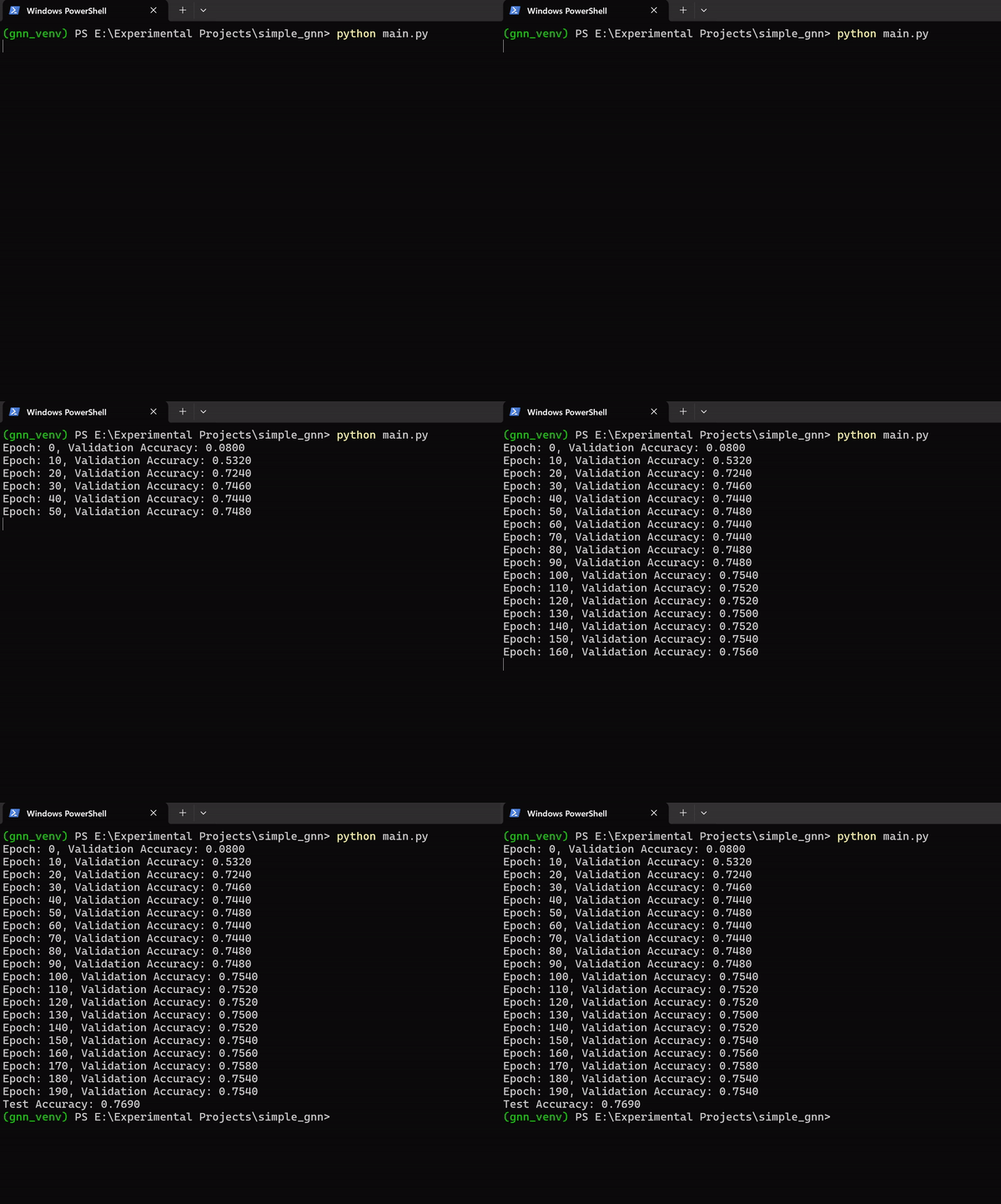
This downloads the Cora dataset, trains the GNN, and evaluates its performance.
Discussion: GNNs vs CNNs
Fundamental Differences
CNNs excel at grid-like data such as images, but they fall short with graphs where connections are irregular and varied. GNNs address this limitation:
- Flexibility: Can work with any graph structure, not just grids
- Message Passing: Nodes update their state by aggregating information from neighbours, unlike CNNs which use fixed filters over fixed positions
- Dynamic: Can adapt to different graph sizes and shapes, whereas CNNs have fixed input sizes
Key Advantages
I've found that GNNs provide several advantages over traditional neural networks:
- Capture Relationships: Understand not just data points but how they're connected
- Generalisation: Apply to various types of graphs, whether social networks, molecules, or transport systems
- Permutation Invariance: Output is independent of node ordering
Applications
GNNs have broad applications across domains:
- Social Networks: Analyzing user connections to recommend friends or detect communities
- Biological Networks: Understanding protein interactions or gene regulatory networks
- Recommendation Systems: Suggesting products based on user-item interaction graphs
- Traffic Networks: Predicting traffic flow by analyzing road networks
- Knowledge Graphs: Enhancing search engines by connecting related concepts
Customization and Extension
Model Customization
You can modify the GNN by editing:
- model.py: Change the architecture (add layers, adjust dimensions)
- data.py: Load different datasets or preprocess data differently
- main.py: Modify hyperparameters like learning rate or hidden dimensions
Future Directions
The field of GNNs is rapidly evolving. Exciting future directions include:
- Scalability: Making GNNs handle larger graphs efficiently (millions of nodes)
- Dynamic Graphs: Dealing with graphs that change over time
- Interpretability: Understanding how GNNs make decisions, crucial for fields like medicine
- Heterogeneous Graphs: Handling graphs with different types of nodes and edges
- Graph Generation: Creating new graph structures for drug discovery or molecular design
Conclusion
I've shown you a practical implementation of Graph Neural Networks using PyTorch Geometric. By structuring the code into modular components, I've created a flexible framework for node classification tasks. The Cora dataset serves as an excellent starting point for understanding how GNNs leverage both node features and graph structure to make predictions.
GNNs represent a powerful paradigm shift in deep learning. They extend neural networks beyond Euclidean data to the rich world of relational structures. With this foundation, you can start experimenting with GNNs and exploring the fascinating world of graph-structured data.
The complete source code is available at github.com/Spartan-119/simple_gnn.